Toy Organization Ideas for a Clutter-Free Kids Room
If you have ever stepped on a LEGO brick at 2 AM, you already know the kind of chaos a kids room can generate.
Toys multiply like rabbits, and before you know it, the floor has completely disappeared under a colorful avalanche of plastic.
The good news? You do not need a bigger room or a miracle to fix this. You just need the right toy organization ideas and a little bit of strategy.
This article walks you through practical, budget-friendly, and genuinely useful ways to bring order to the madness.
Whether your child is a toddler with a hundred stuffed animals or a seven-year-old with an alarming LEGO collection, there is something here that will work for your space.
Start with a Toy Audit (Yes, You Actually Have to Do This)
Before you buy a single storage bin, take stock of what you actually have. Pull everything out, yes everything, and sort it into categories.
You will probably discover toys your child has not touched in two years and about forty-seven random puzzle pieces with no matching puzzles.
The goal of a toy audit is simple: keep what your child loves, donate what they have outgrown, and toss what is broken beyond repair.
This single step cuts your storage problem in half without spending a dime.
How to Sort Toys Effectively
Try sorting into these broad categories before you decide on storage:
- Active play toys (balls, ride-ons, outdoor gear)
- Creative toys (art supplies, building blocks, dress-up clothes)
- Learning toys (puzzles, books, educational games)
- Comfort items (stuffed animals, dolls, plush toys)
Once you know what you are working with, you can choose storage solutions that actually match your needs instead of guessing.
Use Open Bins and Baskets for Easy Clean-Up
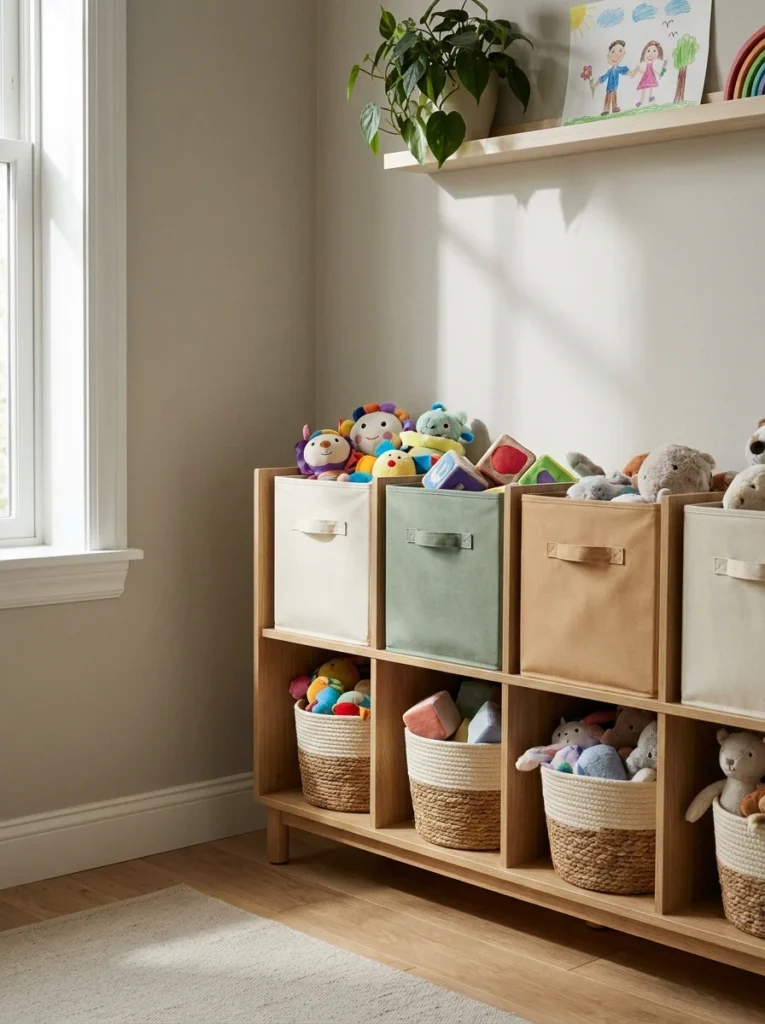
Here is the honest truth about toy storage: if it takes more than five seconds for a child to put something away, it is not going back in its spot.
Open-top bins and baskets are your best friends because they remove all friction from the clean-up process.
Large fabric bins work brilliantly for stuffed animals, soft blocks, and bulky toys. They are soft, lightweight, and forgiving, which means your child can toss things in without breaking anything.
Place them on low shelves or directly on the floor so small hands can actually reach them.
Shop Toy Storage Bins And Baskets On Amazon
The Label Game
Labeling your bins is one of those things that sounds overly extra until you actually try it. For pre-readers, use picture labels alongside text so your child knows exactly where everything belongs.
This small move turns clean-up time from a negotiation into a simple matching activity.
You can print labels at home, use a label maker, or even cut pictures out of old toy catalogs. The fanciness of the label does not matter. What matters is consistency.
Find Label Makers And Labels On Amazon
Toy Rotation: The Secret Weapon Most Parents Miss
Have you ever noticed that your child ignores a toy for months, and then the moment you consider donating it, suddenly it becomes their favorite thing in the world?
Toy rotation uses that psychology to your advantage.
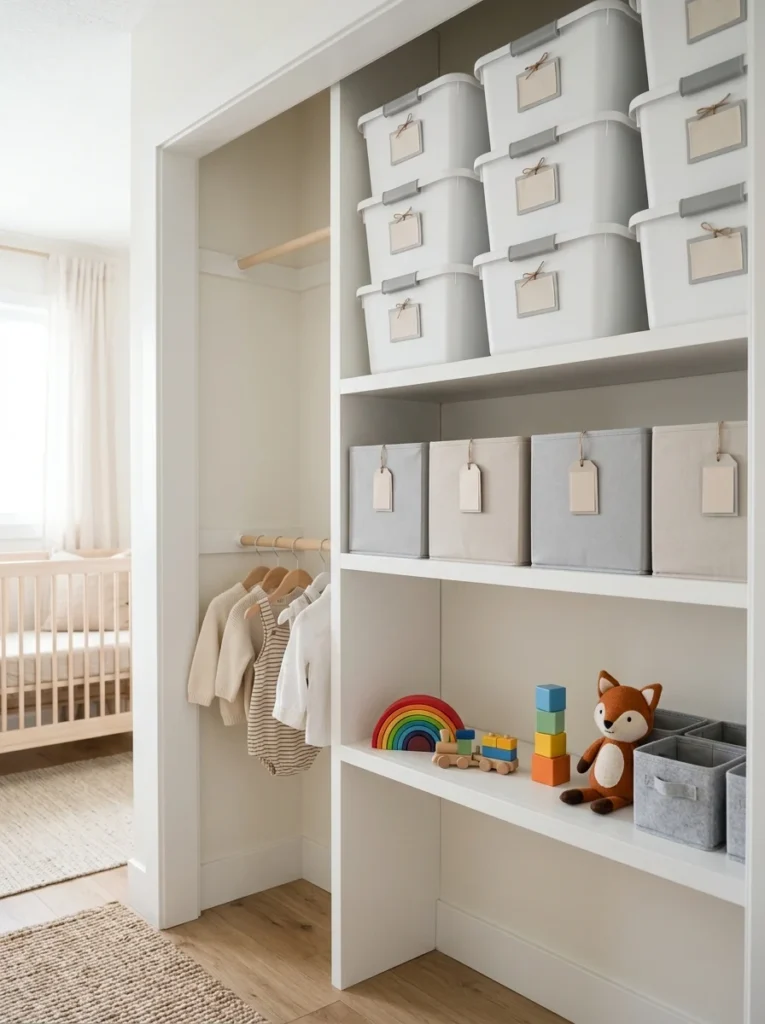
Toy rotation means keeping only a portion of toys accessible at any given time and storing the rest out of sight.
Every few weeks, you swap out the current toys for the stored ones. To your child, it feels like getting brand new toys, and you did not spend a single cent.
How to Set Up a Rotation System
- Divide your child’s toys into two or three equal groups.
- Store the extra groups in labeled bins in a closet, under the bed, or on a high shelf.
- Swap the groups every two to four weeks, or whenever your child starts losing interest.
- Watch your child rediscover toys they had completely forgotten about.
This approach also makes the room feel less overwhelming. Fewer toys out means less visual clutter, and honestly, it also means less for you to clean up every night.
Make the Most of Vertical Space
Floor space in a kids room goes fast, especially when you factor in the bed, a dresser, and whatever fort your child has decided is a permanent structure.
Going vertical is one of the smartest toy organization moves you can make.
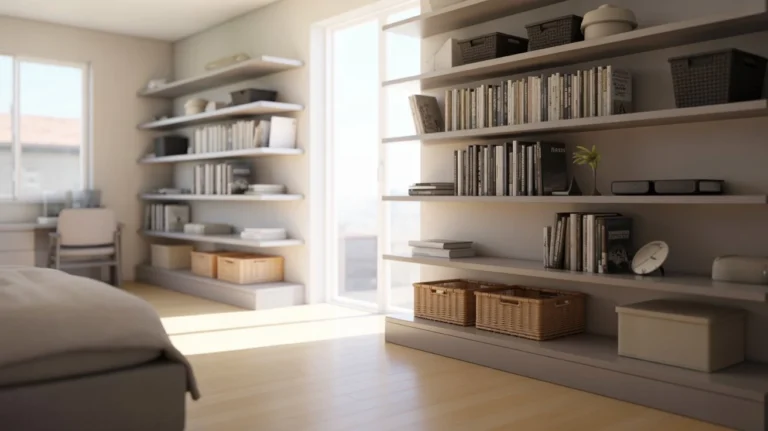
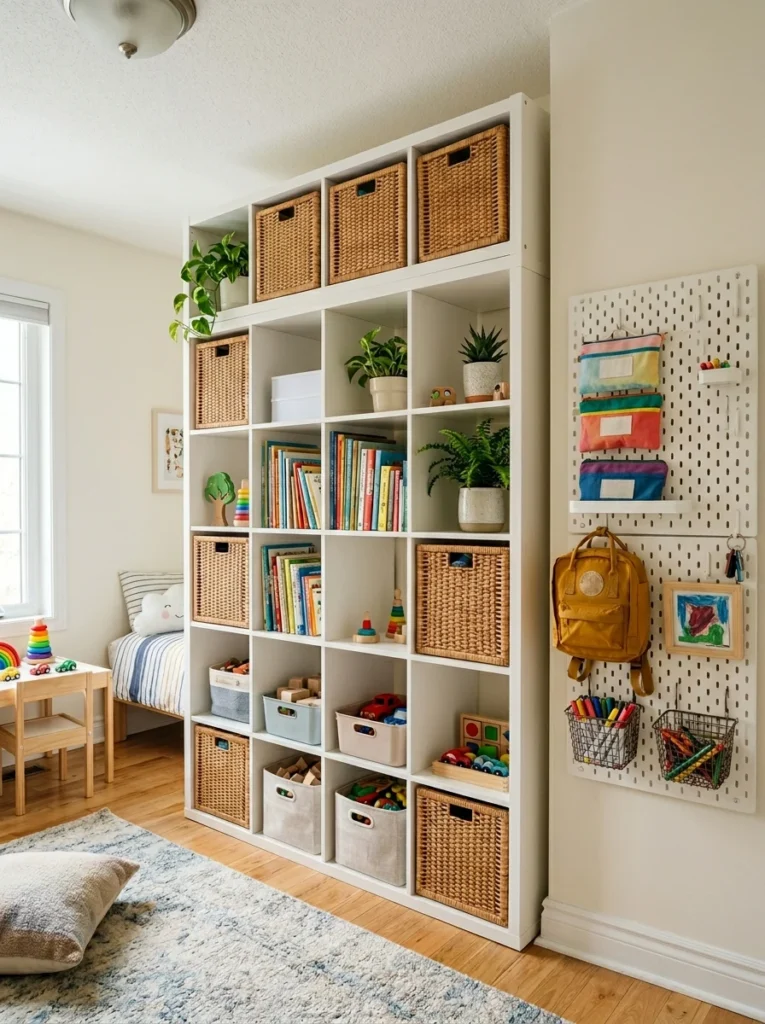
Wall-mounted shelves, floating cubbies, and tall bookshelves all pull storage upward and free up the floor for actual play.
A basic IKEA-style cube shelf unit, for example, gives you multiple compartments for bins, books, and display items without eating up precious floor real estate.
Browse Kids Room Shelves And Cube Storage On Amazon
Pegboards and Wall Hooks
Pegboards are genuinely underrated in kids rooms.
Mount one at an accessible height, add hooks and small baskets, and suddenly you have a home for art supplies, small bags, dress-up accessories, and anything else that tends to pile up on surfaces.
It keeps things visible, which means your child can actually find what they are looking for without emptying every drawer in the room.
Wall hooks near the door also work well for backpacks, costumes, and bulkier items that do not fit neatly in a bin.
Shop Pegboards And Wall Hooks On Amazon
Under-Bed Storage Is Prime Real Estate
Most parents treat the space under the bed as either a dust bunny sanctuary or a dumping ground.
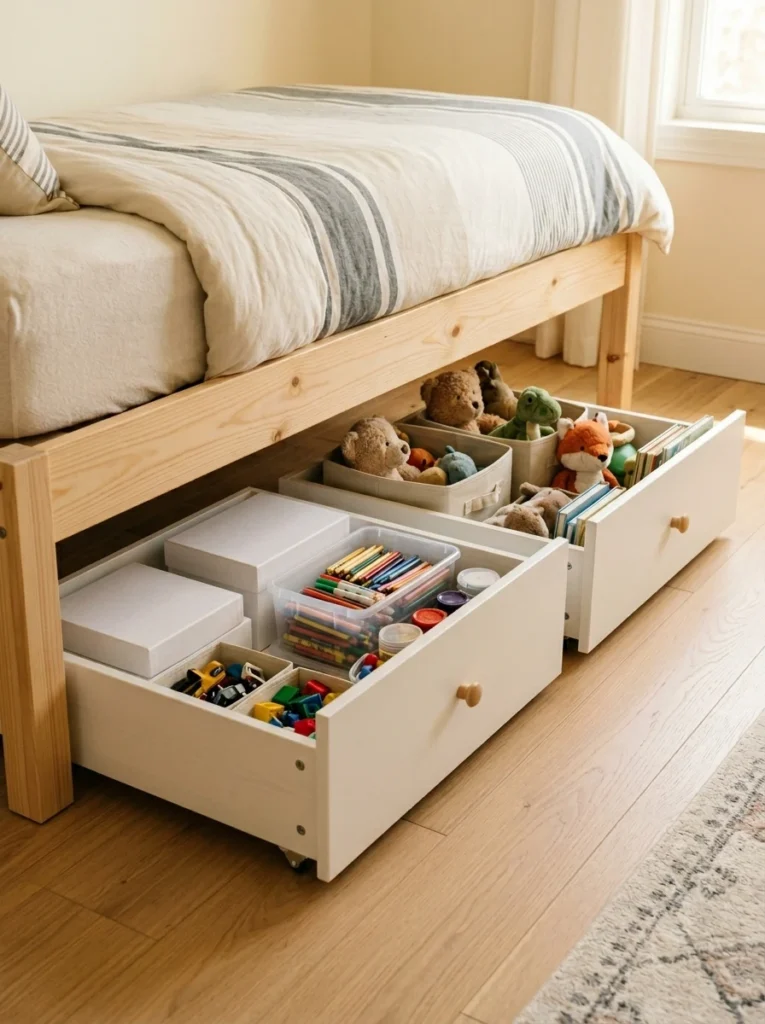
Let’s flip that around. Under-bed storage is some of the most valuable square footage in a small kids room, and it works perfectly for toys that are not used every single day.
Low-profile rolling drawers or flat storage bins slide in and out easily, and they keep toys accessible without cluttering the room.
Use this space for seasonal toys, board game boxes, art supply tubs, or the category of toys your child cycles through less frequently.
Keep the under-bed area limited to a manageable number of bins so it does not become a black hole. Two or three flat containers, clearly labeled, is all you need.
Dedicated Zones Make a Huge Difference
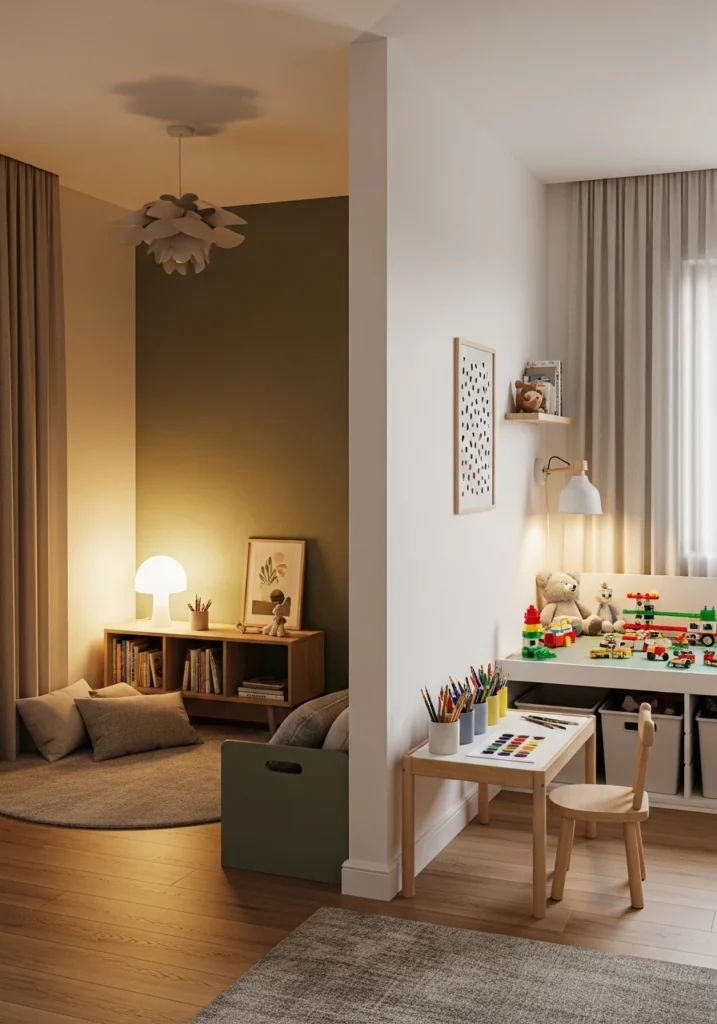
A kids room functions better when it has clear zones for different activities.
Think of it like zoning a tiny apartment. When everything has a dedicated area, both you and your child know exactly where things belong.
Try setting up zones like these:
- A reading corner with a small bookshelf, a soft rug, and good lighting
- A creative zone near a table with art supplies stored in accessible containers
- A building zone with a flat surface or a LEGO table and nearby storage for pieces
- A soft play zone with a mat and a basket of stuffed animals or sensory toys
Zones also help during clean-up because you can say “put everything back in its zone” instead of trying to explain where seventeen different items belong.
Clear Containers Work Magic for Small Pieces
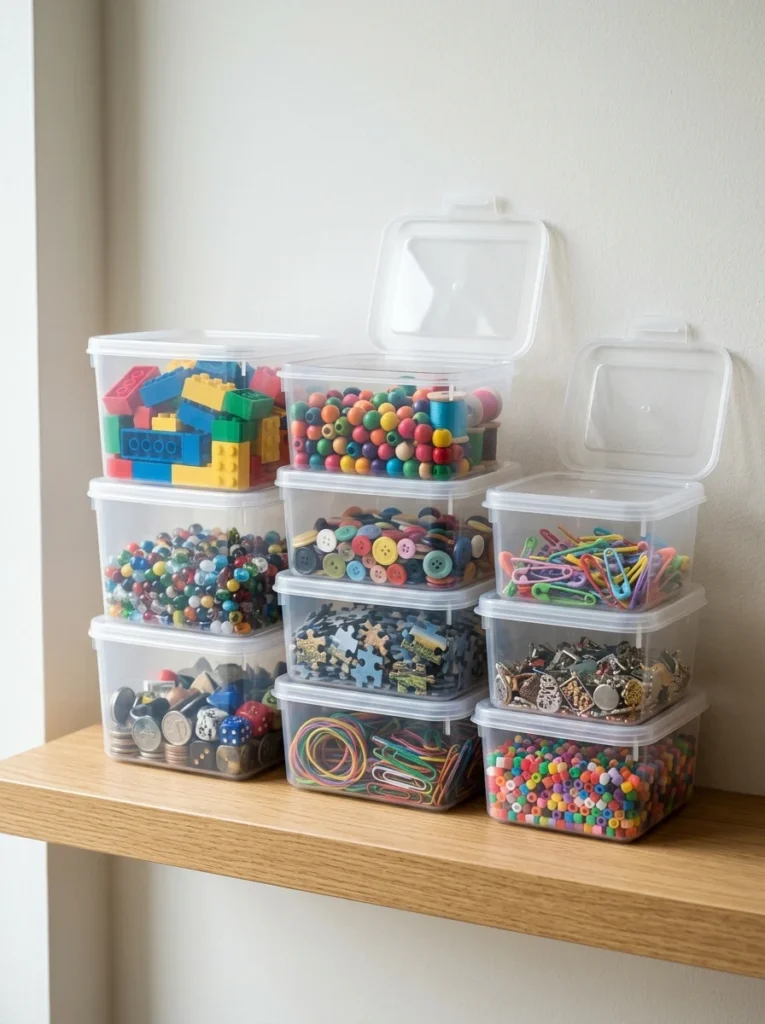
Small toy pieces are the enemy of an organized room. LEGO bricks, puzzle pieces, game tokens, craft beads, anything that fits in the category of “tiny and numerous” needs its own containment strategy.
Clear, stackable containers let you see exactly what is inside without opening every single lid, which saves time and prevents the usual hunt-and-dump routine.
Use dividers inside larger containers for extra organization. A tackle box, for example, works brilliantly for small LEGO sets, art supplies, or craft beads. Label the outside and stack them on a shelf.
Find Clear Storage Containers And Organizers On Amazon
Zip-Lock Bags Are Underrated
For board game pieces, card sets, and puzzle components, resealable zip-lock bags solve a surprising number of problems.
You can group pieces by game, label the bag, and store several in a single box. Nothing migrates, nothing gets lost, and you never have to play “spot the missing piece” again.
Keep the System Maintainable, Not Perfect
Here is where a lot of parents go wrong. They create a beautiful, Pinterest-worthy organization system, and within two weeks it has completely collapsed.
Why? Because it was designed for a photo shoot, not real life.
The best toy organization system is the one your child can actually maintain. That means fewer categories, simpler storage solutions, and a clean-up routine that takes five minutes, not thirty.
Forget the elaborate custom labels and the matching containers in four sizes. Start simple, observe what actually works, and adjust from there.
Set a weekly reset where you spend ten minutes putting things back where they belong. Involve your child in this process so they build the habit early.
Final Thoughts: Small Changes, Big Results
You do not need to overhaul the entire room in one weekend to see real results. Start with one corner, one shelf, or one category of toys. Get that sorted, see how it works, and build from there.
The goal is not a perfect room. The goal is a functional room where your child can find what they want, play freely, and put things back without needing a manual.
A few smart storage choices, a consistent routine, and a willingness to let go of toys that no longer serve your child will get you further than any expensive organizational system ever could.
And if you do end up stepping on a LEGO again despite all of this, just know you are in very good company.
What Are the Best Toy Organization Ideas for Small Kids Rooms?
The best toy organization ideas for small kids rooms focus on maximizing vertical space and minimizing floor clutter.
Use wall-mounted cube shelves, under-bed rolling drawers, and hanging pegboards to pull storage upward.
Pair these with open-top bins at a child-accessible height so your child can independently put toys away without your help.
How Do You Keep a Kids Room Organized When Toys Keep Multiplying?
The most effective way to stay ahead of toy clutter is to combine regular toy audits with a toy rotation system.
Every few months, sort through toys, donate what your child has outgrown, and divide the remaining toys into two or three groups.
Rotate these groups every few weeks so the room stays manageable and your child stays genuinely interested in what is available.
What Type of Storage Bins Work Best for Organizing Kids Toys?
Open-top fabric bins and clear stackable containers are the two most practical options for organizing kids toys.
Fabric bins work well for bulky or soft items like stuffed animals and dress-up clothes, while clear containers with lids are ideal for small pieces like LEGO bricks, puzzle components, and craft supplies.
The key is choosing storage your child can use independently.
At What Age Can Kids Start Putting Their Own Toys Away?
Most children can begin participating in toy clean-up as early as age two with simple, guided prompts. The trick is making the system easy enough for them to follow without help.
Use picture labels on bins, keep storage at their height, and limit the number of categories so clean-up feels achievable rather than overwhelming.
Building this habit early saves you years of repeated battles over a messy room.
How Do You Organize Toys Without Buying a Lot of New Storage?
You can organize toys effectively without spending much by starting with what you already have at home.
Repurpose shoeboxes, kitchen containers, and zip-lock bags for small toy pieces and board game components.
Use under-bed space with flat bins you may already own, and clear out one shelf in an existing bookcase for a designated toy zone.
A toy audit alone, where you sort and donate unused items, often solves half the clutter problem at zero cost.